‘I visited remote Scottish island removed from maps – what I found was disturbing’ | Travel News | Travel

Ellie Whitby travelled to a mysterious island in northwest Scotland (Image: EllieMarieTV/YouTube)
A brave content creator has explored a remote Scottish island that was previously erased from maps, but what she found was terrifying. During her exploration of so-called “banned” sites last year, Ellie Whitby, who runs EllieMarieTV on YouTube, journeyed to an enigmatic island off northwest Scotland, infamous for its sinister history.
Ellie and a companion drove to Gruinard Island, dubbed “Anthrax Island,” a chilling name it acquired after scientists contaminated the terrain whilst carrying out secret biological weapons experiments during World War II. Anthrax is a potentially fatal infectious disease typically caused by the Bacillus anthracis bacterium, rendered the island too dangerous for humans and livestock.
Despite its grim past, Ellie was undeterred. She admitted the venture was “very scary” but was determined to speak with local residents about the island and, bravely, sought someone willing to ferry her across the water.
READ MORE: English-speaking islands are a sunny paradise and are only 2 hours from London
READ MORE: I’ve been to more than 400 islands – there’s one that is the best in the world

Gruinard Island is also known as “Anthrax Island” (Image: Getty Images/iStockphoto)
She explained: “So, we’re in the local town and see if there’s anyone willing to take me out to Anthrax Island, and I want to know their opinions on this. What do they think about this massive, secret government cover-up that happened a mile off their shores?”
Ellie went on to speak with local residents, one of whom confirmed that the government kept the island under wraps, whilst another claimed that the experiments led to sheep deaths on the mainland.
She eventually found a kayaker named Will, who agreed to take her to the island. She remarked: “It was time to be one of very few people to ever step foot on an island hidden from the entire world and see if any of the conspiracies are true.”
As she set out on the water, she added: “I literally never used to leave my room out of fear of germs, and now I’m going all the way to Anthrax Island. I think my therapist would be proud of me or, actually, very concerned.”

A scientist walks past a warning notice about anthrax contamination on Gruinard Island in July 1986 (Image: Daily Record)
In the end, they reached the island near a cave system, though Ellie appeared to have second thoughts. After confirming there were no “nuclear bunkers,” she declared that she wasn’t “stupid enough” to stay any longer.
In 1942, then-Prime Minister Winston Churchill, concerned that Nazi Germany had developed a biological bomb, instructed scientists to investigate ways of weaponising the lethal bacterial infection, according to the BBC.
Situated in Gruinard Bay, the 522-acre island became a testing ground; residents in nearby settlements were unaware of the experiments, though rumours reportedly began circulating once livestock started dying.

Scientists in an eight-wheel moon buggy work on the decontamination of soil from anthrax spores (Image: Daily Record)
In a 2022 documentary, The Mystery of Anthrax Island, Edward Spiers, emeritus professor at the University of Leeds, explained: “The aim was to test whether the anthrax would survive an explosion in the field. They didn’t know that, and then would it remain virulent thereafter.
“Eighty-odd sheep were tethered at various stages downwind of the likely explosion. The explosion was done by remote control. It isn’t a great bang, a draught of highly potent spores moving down on the wind and causing infection and death wherever it goes.”
The tests had catastrophic consequences, with the sheep quickly developing symptoms and dying; their bodies were subsequently burned or buried beneath rubble.

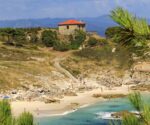
Ellie landed on the island near a cave system (Image: EllieMarieTV/YouTube)
The covert trials lasted until 1943, but the impact of the experiments was long-lasting. The highly resistant anthrax reportedly remained in the soil for decades, and access to the island became strictly prohibited.
According to Lethbridge News, Gruinard Island was even removed from some maps over fears that terrorist groups “would travel to the island to procure samples” of the lethal bacteria.
Deemed a success, the scientists concluded their work and returned to Porton Down, a secretive government facility in Wiltshire where research into diseases and chemical weapons is conducted.
Churchill’s proposed biological weapon was never deployed, and a militant group known as the Dark Harvest Commando of the Scottish Citizen Army (DHC) pushed the government to decontaminate the island.
One of their tactics involved placing a bucket of contaminated soil outside Porton Down. Years later, scientists undertook efforts to cleanse the island, which reportedly proved successful.
The UK government officially declared the island anthrax-free in 1990, marking the end of a staggering 48-year quarantine period.