Red line crossed as drone airstrikes push Pakistan and Afghanistan to the brink | World | News

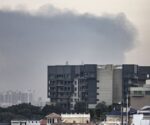
Flames rise from a fuel depot allegedly hit in a Pakistani airstrike near Kandahar airport (Image: QUDRATULLAH RAZWAN/EPA/Shutterstock)
Pakistan’s president warned neighbouring Afghanistan’s Taliban government on Saturday that it had “crossed a red line” by launching drone attacks on civilian areas, and claimed Kabul had brought “grave consequences upon itself”. The statement by Asif Ali Zardari was the latest development in what has become the deadliest fighting yet between the two neighbours.
The cross-border clashes, which erupted late last month, have shown no signs of abating despite efforts by China and Turkey to broker a ceasefire. Pakistan said its forces intercepted the drones launched on Friday, but falling debris injured two children in the city of Quetta and two people elsewhere in the country.
Read more: Weak Starmer is out of his depth – every tinpot dictator knows can they walk all
Read more: Nuclear power declares ‘open war’ as major city rocked by overnight strikes

People survey the damaged houses following alleged Pakistani airstrikes in Kabul (Image: SAMIULLAH POPAL/EPA/Shutterstock)
On Friday, the Afghan Taliban government accused Pakistan of conducting airstrikes in Kabul, the country’s capital, and other areas in eastern Afghanistan, saying at least six civilians were killed and 15 others injured.
Hours later, Kabul claimed its air force had responded by targeting military installations near Islamabad, Pakistan’s capital, and in north-western Pakistan.
Pakistan denied targeting civilians, saying its operations were focused on Pakistani Taliban militants and their support networks. Islamabad has referred to the conflict as an “open war” — adding to concerns among the international community about regional stability as the US-Israeli war with Iran has engulfed the Middle East and beyond.
Afghan government spokesman Zabihullah Mujahid said Pakistani aircraft had also struck fuel depots belonging to the private airline Kam Air near the airport in the southern city of Kandahar, which he said supplies civilian and UN flights.

President Of Pakistan Asif Ali Zardari (Image: Getty)
Pakistan accuses the Afghan Taliban government of harbouring Pakistani militant groups — mainly the Pakistani Taliban — that cross the porous, volatile border between the two countries to stage attacks against Pakistani forces, and of allying with its arch-rival, India. Kabul denies harbouring militant groups.
On Friday, a roadside bomb targeting Pakistani police killed seven officers in the north-western district of Lakki Mawat.
Zardari slammed the government in Kabul.
He said: “While the Afghan terrorist regime seeks negotiations with our friendly countries, it crossed a red line by attempting to target our civilians.”
Afghanistan’s Defence Ministry said on Saturday on X that its defence forces along the border in the eastern provinces of Kunar and Nangarhar had captured a Pakistani post and killed 14 Pakistani soldiers. In Islamabad, Pakistan’s Information Ministry said the claim was baseless.
Pakistani Prime Minister Shehbaz Sharif’s spokesman, Mosharraf Zaidi, said the “Afghan Taliban are spending more time weaving fantasies” than they are getting rid of “terrorist organisations enjoying Afghan Taliban regime hospitality”.
He said on X that such propaganda would not force Pakistan to end its counter-terrorism operations. He insisted: “Only the end of terrorism from Afghan soil to Pakistan will.China’s Foreign Minister Wang Yi urged a peaceful resolution of the Afghanistan-Pakistan dispute on Friday, warning that the use of force would worsen tensions and threaten regional stability. His remarks were reported on Saturday by China’s official Xinhua News Agency, which said Wang had spoken with Afghan Foreign Minister Amir Khan Muttaqi.
Wang said China’s special envoy was shuttling between the two countries in an effort to promote restraint and encourage a ceasefire. Muttaqi said Afghanistan sought regional peace and did not want a military conflict, adding that dialogue remained the only solution and urging China to play a greater role.
A Qatari-mediated ceasefire in October briefly reduced tensions, but subsequent talks in Turkey failed to produce a lasting agreement.