Shameless reason French police let overpacked migrant boat sail to UK | World | News

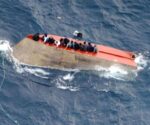
A flimsy dinghy packed with migrants headed for the UK (Image: Getty)
French police refused to intercept a UK-bound migrant boat in which two people died because it was deemed “too heavily laden” to stop safely, a court has heard. Disturbing details of the fatal decision emerged on Friday during the fast-track trial of a Sudanese people smuggler referred to only as Mukhalas, 34.
He was sentenced to two years in prison after admitting being at the helm of a boat stopped in the Aa canal at Gravelines, near Dunkirk, last Wednesday. Maritime police arrested him and 15 others on board, describing their dilapidated dinghy as “a floating coffin”. A state prosecutor told Dunkirk Criminal Court: “Very few were wearing lifejackets, the engine was failing, and the boat was lying dangerously low in the water.”
Read more: Outrage at people smuggler let into Britain days after conviction in France
Read more: Gang that smuggled 1,000 small boat migrants into UK ‘charged £43k a trip’

A migrant camp near Gravelines in France (Image: Getty)
The so-called “taxi boat” was the second of two due to pick up UK-bound migrants on Gravelines beach.
But the first vessel was waved on because, as the state prosecutor told the court: “There were too many people on board for the police to safely intervene and detain those on board.”
The prosecutor continued: “The gendarmes approached the first boat. It was carrying twenty-two migrants. The authorities decided to let it continue on its way. They deemed it too heavily laden to intercept safely.”
Soon afterwards, an Afghan and a Sudanese national died during a chaotic attempt to board migrants waiting on the beach at Gravelines.
A prosecuting source said: “The boat approached the shore with about twenty people already on board to collect dozens more who were waiting on the beach.”
The source added: “There was chaos on the beach, with many falling into the water, before the boat eventually departed. Following the tragedy of the two deaths, the vessel set off for the United Kingdom with nearly 80 people on board and has now arrived.”
Despite the arrival of emergency medical teams by helicopter, two people were pronounced dead at Gravelines, while a third was taken to hospital.
The deaths marked the first this year on the perilous English Channel migrant crossing between France and Britain.
Mukhalas had been residing legally in France, while falsely claiming to be a professional footballer based in Nantes, in the west of the country.
He was found guilty of “aiding and abetting illegal immigration under conditions that endanger the lives of others.”
In mitigation, the defendant said: “I was paid the equivalent of around £1000 to pilot the boat, but was unaware it would be used to transport migrants.”
Dunkirk prosecutors also confirmed that four men, including a Turkish passenger from the first boat who was rescued after falling into the sea, remain in custody.

Foreign Secretary Shabana Mahmood (Image: Getty)
All of the men – who have not been named – face charges relating to assisting illegal immigration.
More than 100 migrants successfully made the crossing on Wednesday, according to French figures.
They add to the 4,441 migrants who have arrived in Britain in around 70 boats so far this year.
It came as Britain and France agreed a temporary two-month extension to the current deal that funds French police patrols on northern beaches after failing to reach new terms.
The UK will pay France £16.5 million to cover the cost of nearly 700 officers patrolling northern France until May.
The extension was designed to prevent a spike in screenings when the deal expired.
Talks on a new three-year agreement remain deadlocked over Home Secretary Shabana Mahmood’s demands for more officers on beaches.
She is also pushing for strict payment-by-results conditions, which the French strongly oppose.
The ongoing dispute over “payment-by-results” stems from British frustration regarding the intercept rate of small boats. While the UK has committed hundreds of millions of pounds to French beach security over the last several years, the number of successful crossings often fluctuates based on weather conditions rather than police presence alone.
French officials have consistently argued that their sovereignty is not for sale and that “performance targets” are inappropriate for complex humanitarian and policing operations.
Furthermore, the “taxi boat” phenomenon mentioned in court represents a shift in smuggling tactics. Instead of launching directly from the shore with a full load, empty or lightly manned vessels now travel along the coast or through inland waterways like the Aa canal to “collect” migrants at pre-arranged points.
This makes it harder for land-based patrols to stop the boats before they are already in the water and deemed too risky to board by maritime authorities.